3-hour assessment
180 minutes
ACER runs ISAT as one continuous online multiple-choice test.
By Samarth Vemala and Mark Xu · Published · Updated
The International Student Admissions Test (ISAT) is a three-hour, remote-proctored admissions test developed by ACER for international applicants to specified medicine and health-related courses.
This guide explains who may need the test, its 2026 format and dates, scoring and results, pacing, preparation, and the practical differences between ISAT and UCAT ANZ.
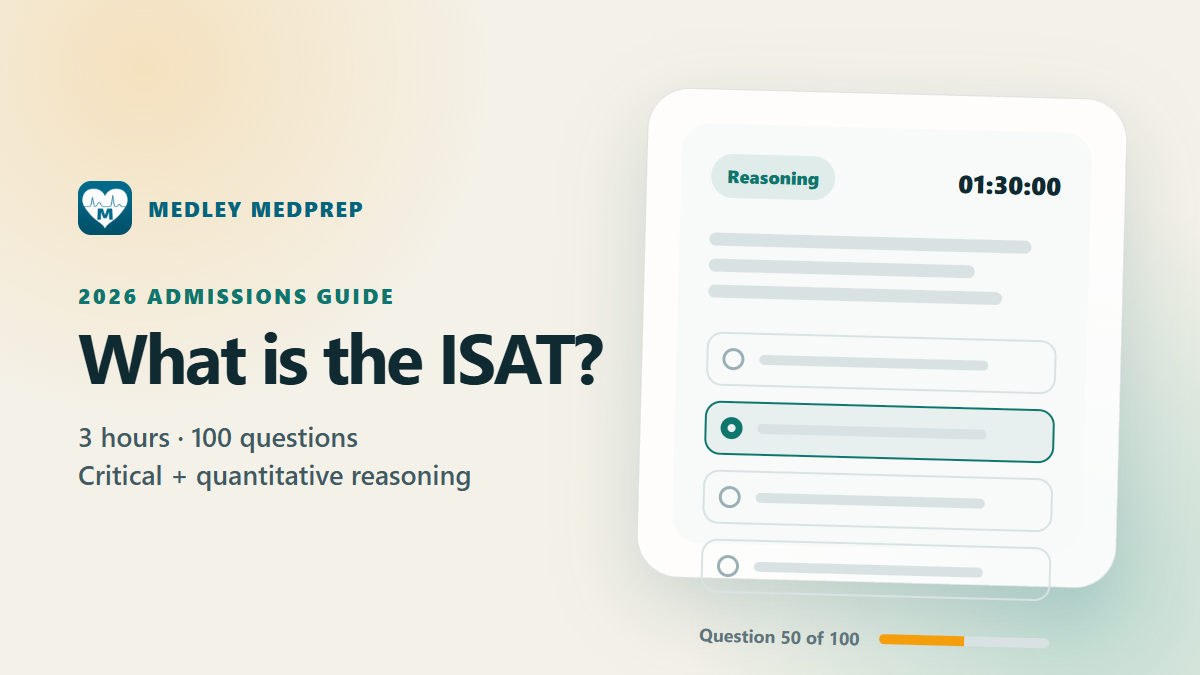
3-hour assessment
180 minutes
ACER runs ISAT as one continuous online multiple-choice test.
100 questions
1.8 min each
That works out to an average of 108 seconds per question across the full paper.
4 test windows
2026 cycle
All 2026 sessions are remotely proctored. The final two days of each window are reserved for resits.
Results timing
Within 2 weeks
ACER publishes a no-later-than result date for each 2026 test window.
Validity
2 years
Results remain current for two years, with at least 12 months required between sittings.
Marking approach
No negative marking
ACER advises candidates to attempt as many questions as possible because wrong answers are not penalised.
Exam Breakdown
The ISAT is not a biology, chemistry or memorisation exam. ACER describes it as a cross-curricular reasoning assessment that measures how well you analyse information, make logical deductions and form judgements in unfamiliar contexts.
This is about understanding written material, extending ideas, drawing sensible conclusions and evaluating arguments. The stimulus material usually draws from humanities and social science contexts.
This tests numerical interpretation, decision-making, and problem solving using mathematical and scientific information. Strong performance depends on disciplined arithmetic and calm handling of data.
What matters strategically: ACER explicitly notes that ISAT is not a subject knowledge test, that there is no negative marking, and that cramming offers limited benefit. That means your preparation should focus on reading quality, reasoning quality and pace control.
Eligibility
ISAT is not a general requirement for every international medical applicant. ACER lists specific courses that require the test, and each university controls its own admissions rules.
Course requirements can change. Check the current ACER ISAT course list and the university’s own admissions page before registering.
2026 Registration
All 2026 ISAT sessions are remotely proctored. ACER reserves the final two days of each window for resits, so first-time sittings must be booked earlier in the window.
Test fee
AUD $435
Deferral fee
AUD $72
Between sittings
At least 12 months
These dates and fees were checked on 26 August 2026. Confirm availability and booking conditions on the official ACER registration page before making travel, study or application plans.
Scores and Results
Your statement of results reports Critical Reasoning, Quantitative Reasoning and Overall scores. Universities decide how they use those results, so there is no universal ISAT pass mark.
Critical Reasoning, Quantitative Reasoning and Overall scores are each scaled from 100 to 200. The Overall score is the scaled average of the two reasoning scores.
ACER uses Item Response Theory, so a raw count of correct answers cannot be converted directly into a scaled score. Question characteristics are considered in the calculation.
There is no guaranteed “good” score. Percentile tables describe performance relative to a cohort and can change, while each university sets its own admissions interpretation.
Results are released by ACER’s published deadline after each window and remain current for two years. Candidates must wait at least 12 months before sitting again.
A scaled score is intended to be comparable across sittings, but its associated percentile may vary between cohorts. See the official ACER result explanation. For practice data inside Medley—not an ACER score conversion—read our mock scoring and accuracy guide.
Pacing Statistics
ACER’s official checkpoint is to be around Question 50 at 90 minutes. Dividing that evenly gives a simple planning reference of about 25 questions every 45 minutes—not a rule for every question.
Use these as prompts, not hard cut-offs.
45 min
Question 25
90 min
Question 50
135 min
Question 75
180 min
Question 100
If you are behind, avoid trying to recover all the time on one difficult item. Make your best supported choice and reassess at the next checkpoint.
UCAT Comparison
The exams create different timing demands. ISAT provides a single average across one continuous paper; UCAT ANZ gives each subtest its own fixed time limit.
UCAT ANZ uses four separately timed subtests. The chart therefore shows each subtest rather than combining them into one pace figure.
Calculated from official 2026 times and item counts. Values are rounded, and actual time varies by item type.
Chart data in seconds per item: ISAT 108, UCAT VR 30, UCAT DM 63, UCAT QR 43, UCAT SJT 23.
Comparison Table
Use this table as a fast admissions-planning reference. The tests overlap in purpose, but they reward different preparation habits and produce different score reports.
| Feature | ISAT | UCAT ANZ |
|---|---|---|
| Primary use | Used for international applicants to selected high-stakes university courses, especially medicine and related programs. | Used by the UCAT ANZ Consortium for medicine, dentistry and clinical science admissions in Australia and New Zealand. |
| Structure | One continuous paper focused on critical and quantitative reasoning. | Four separately timed subtests: Verbal Reasoning, Decision Making, Quantitative Reasoning and Situational Judgement. |
| Total test time | 3 hours for 100 questions. | Just under 2 hours, plus timed instruction sections. |
| Time pressure | Lower per-question speed pressure, but longer endurance and focus demands. | Much faster per-question pace, with rapid context-switching between subtests. |
| Scoring | Critical Reasoning, Quantitative Reasoning and Overall scores are each reported on a 100–200 scale, with percentile information. | 300 to 900 per subtest, total cognitive score 900 to 2700, Situational Judgement reported separately 300 to 900. |
| Result validity | Current for 2 years. | Valid for the current admissions cycle only. |
In practice, ISAT preparation should include sustained mixed reasoning and measured checkpoints. UCAT ANZ preparation needs to reflect each subtest’s separate timing and question style.
Preparation
Use your own error data to decide what deserves the most attention. The principles and example timeline below provide structure without assuming that every student has the same baseline or schedule.
Five preparation principles
Use the halfway rule ACER gives: by 90 minutes, aim to be around Question 50. That automatically gives you 25-question checkpoints every 45 minutes.
ISAT does not test curriculum knowledge. Practise reading complex material, identifying assumptions, testing conclusions and working accurately with numerical data.
Never leave easy points behind. If a question is dragging, eliminate the weakest options, mark a choice, and return later if time remains.
Sort mistakes into categories such as misread stem, rushed arithmetic, weak inference, over-assumption or poor elimination. Recurring categories give you a clearer target for the next practice session.
ACER's practice tests are designed to mirror the balance of a full paper. Treat each attempt as a data point for pace, accuracy and fatigue, not just a raw score snapshot.
Example 8-week framework
Adapt the sequence to your deadline and judge progress by reasoning quality, accuracy and pacing—not a fixed number of hours.
Weeks 1-2
Find your starting pace, weakest reasoning pattern and strongest question families.
Weeks 3-4
Work on argument evaluation, inference, assumption detection and conclusion testing.
Weeks 5-6
Tighten estimation, ratio work, graph reading and multi-step numerical decisions under time pressure.
Week 7
Practise switching between verbal and numerical reasoning without losing rhythm.
Week 8
Run one realistic paper, review deeply, then reduce load so you arrive fresh on test day.
Practice
ISAT rewards reasoning under sustained time pressure, which is hard to rehearse by reading alone. These are the practice formats worth using, and what each one is actually good for.
Ten real-format questions in the exam simulator, with no account and no payment card. The quickest way to see the question style and interface.
Try 10 questionsA complete 100-question, 3-hour paper is the only practice that tests endurance and pacing together. A free account includes one diagnostic mock.
Start a free diagnostic mockShorter targeted sets in critical and quantitative reasoning, for drilling one reasoning pattern at a time between full papers.
See what each plan includesACER publishes its own ISAT practice tests. Treat these as the source of truth for exam rules and question style, whatever else you use alongside them.
ACER preparation pageWhichever ISAT practice resources you use, review by error pattern rather than by score alone. A fuller set of guides and articles is in the ISAT resources hub.
FAQs
Quick answers to the questions applicants commonly ask when deciding whether they need ISAT and how to plan for it.
ISAT stands for International Student Admissions Test. It is developed by ACER and used as one component of admission for selected university courses, particularly for international applicants.
The ISAT runs for 3 hours and contains 100 multiple-choice questions. That gives you an average of 1.8 minutes per question, although some will take far less and others more.
No. ACER states that there are no marks deducted for incorrect answers, so attempting as many questions as possible is strategically important.
There is no universal ISAT pass mark or guaranteed 'good' score. Universities interpret results differently and competition changes by course and admissions cycle, so compare your result with the current requirements for every program you are applying to.
They are difficult in different ways. ISAT is longer and rewards sustained reasoning endurance, while UCAT ANZ is more intensely time-pressured and split into fast subtests.
ACER states that results remain current for 2 years, but candidates may only re-sit after 12 months have elapsed from the previous sitting.
Internal editorial review
Published 25 May 2026
Last reviewed 26 August 2026
Samarth Vemala, Medley co-founder and Monash medicine student, reviewed the ISAT sections. He received an ISAT score of 190, reported at the 99th percentile for his sitting year.
Mark Xu, Medley co-founder and medicine student, reviewed the UCAT comparison. His UCAT result was reported at the 99th percentile for his sitting year.
Medley’s co-founders performed this internal review. Medley is independent and is not affiliated with or endorsed by ACER or the UCAT ANZ Consortium.
Meet the foundersPrimary sources
Exam rules and dates can change. We checked the claims on this page against the official 2026 sources below.
Next Step
Create a free account for one full diagnostic mock exam, 50 practice questions, and a basic performance and score report. No payment card is required.